Methodology

How we build behavioral intelligence

A look inside the method we apply to every Mirra Labs study — shown through examples across Southeast Asia.

Craft
Human-designed segments, thousands of distinct agents
Reach
Seven markets across SEA, proven method
Rigor
A four-check Validation Protocol
Grounded
Academic foundations in behavioral research
1
Question
2
Population
3
Diversity
4
Decomposition
5
Processing
6
Delivery

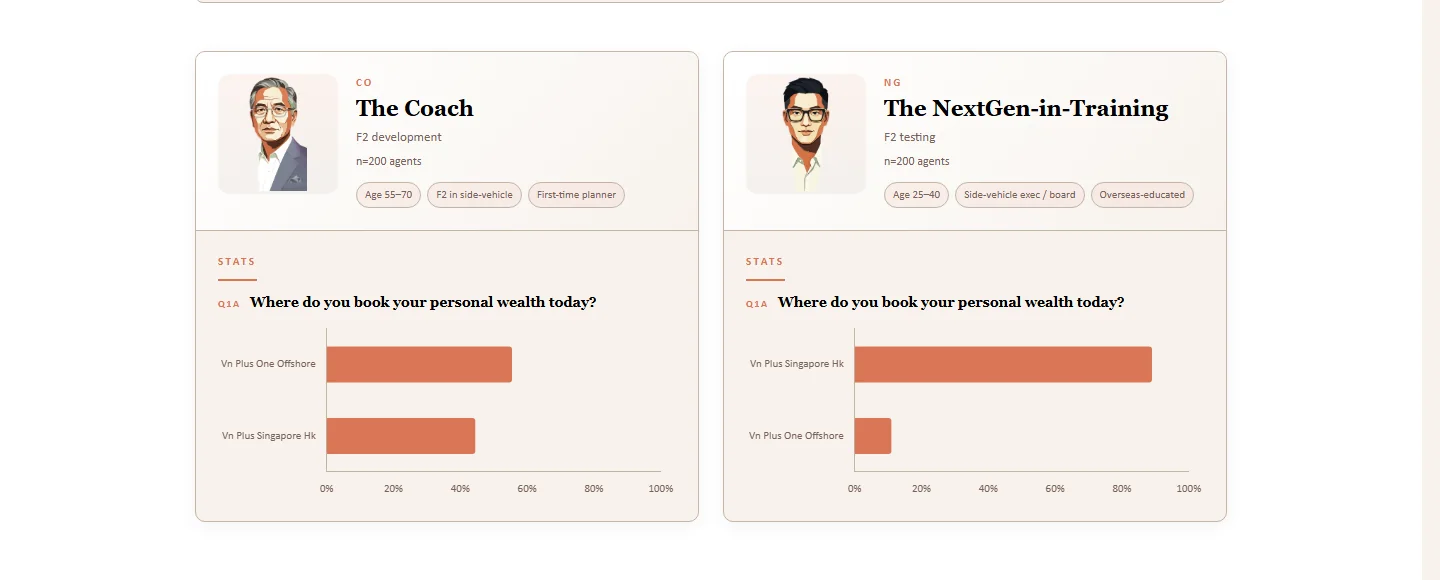
Example: Singapore — mass-affluent wealth consolidation

Step 1 of 6

The question we set out to answer

Every study starts with a real commercial decision — framed with stakes, constraints, and the specific action someone needs to take.

Private Bank MAS Regulatory Frame Offshore wealth outflow signal

Which mass-affluent Singaporean segments would consolidate their wealth relationship with a single bank — if offered an integrated private-banking tier?

At stake
AUM capture
At stake
Cross-sell depth
At stake
Segment prioritization

We're not asking who might say yes. We're asking who would act, why, and what would stop them.

Example: Vietnam — urban households

Step 2 of 6

Designing the population, segments, and behavioral frame

Populations start from published, official sources. Segments are designed — not discovered — so that every finding can be traced back to a decision frame you recognize.

Calibrated against
Official national sources
The hard baseline — census, credit, regulatory filings.

General Statistics Office of Vietnam State Bank of Vietnam Ministry of Finance Vietnam
Multilateral cross-checks
Independent views that triangulate the baseline.

The World Bank Asian Development Bank International Monetary Fund
Calibrated segment matrix
Urban Vietnamese households — income × life stage.
Young single
Young family
Established family
Empty nester
Affluent
38K HH
High-earner professionals
82K HH
Dual-career, no kids yet
124K HH
Peak-income households
71K HH
Pre-retirement wealth
Upper
income
142K HH
Urban single professionals
318K HH
Dual-income, 1 child
405K HH
School-age household
211K HH
Children out of home
Mid
income
486K HH
Early-career, living alone
812K HH
Saving for first home
954K HH
Education-focused spend
523K HH
Helping adult children
Lower-mid
income
672K HH
Informal / gig workers
1.04M HH
Dependent on one earner
1.18M HH
Multi-generational home
698K HH
Pension-dependent
1 The Validation Protocol — Check 1
Source Triangulation
Every population anchor is cross-checked against at least two independent sources before any agent is built.

Example: Indonesia — young urban professionals

Step 3 of 6

One segment. Thousands of distinct agents.

No two agents are alike — and the differences between them are where the strategic signal lives.

One segment
Young urban professional
Age 25–34 · Jakarta, Surabaya, Bandung · Monthly income Rp 8–20M
Thousandsof distinct agents generated inside this segment — each with a different life, a different decision calculus, a different story.
Faith-aligned banking
Raka · 28 · M
Jakarta · Copywriter · Rp 11M/mo
Behavioral traits
  • Avoids riba — BSI only, no credit card
  • Saving for umrah in 3–5 years
Digital-first investor
Reza · 32 · M
Jakarta · Product Manager · Rp 18M/mo
Behavioral traits
  • Livin' + Bibit + Pluang across 3 apps
  • ETF and crypto-curious
Heavy credit user
Andi · 31 · M
Surabaya · Software Eng · Rp 20M/mo
Behavioral traits
  • Two CCs, pays in full monthly
  • Regional travel, FX fee-sensitive
Household builder
Sari · 33 · F
Jakarta · Lawyer · Rp 16M/mo
Behavioral traits
  • Dual-income, saves jointly
  • Researching KPR for first home
Variable cashflow
Dimas · 29 · M
Jakarta · Freelance UX · Rp 8–22M/mo
Behavioral traits
  • Income swings 3x month-to-month
  • Holds 4-month emergency buffer
Cash-anchored
Putri · 32 · F
Surabaya · Teacher · Rp 9M/mo
Behavioral traits
  • BRI payroll, cash for daily spend
  • Low digital comfort, debt-averse
Lifestyle spender
Faiz · 27 · M
Bandung · Sales Exec · Rp 14M/mo
Behavioral traits
  • Uses BNPL for lifestyle purchases
  • Dining, concerts, new gadgets
Owner-operator
Bagus · 30 · M
Surabaya · Family shop · Rp 12–18M/mo
Behavioral traits
  • Mixes personal and business funds
  • Supplier credit, seasonal inventory
Global commuter
Intan · 28 · F
Jakarta · Consultant · Rp 22M/mo
Behavioral traits
  • Wise for FX, monthly client travel
  • Rate and fee sensitive
Pension-anchored
Budi · 33 · M
Bandung · PNS · Rp 10M/mo
Behavioral traits
  • BNI + Taspen, 20-year horizon
  • Strongly debt-averse
Shift-income saver
Ratna · 29 · F
Surabaya · Nurse · Rp 9M/mo
Behavioral traits
  • Irregular shift bonuses, cash-heavy
  • Gold saver to hedge inflation
Micro-entrepreneur
Yuni · 31 · F
Bandung · Warung · Rp 7–15M/mo
Behavioral traits
  • QRIS daily turnover, no biz account
  • Supplier credit for inventory
12 shown here — thousands generated per study. Each agent carries a distinct identity, economic reality, and decision calculus; variance is calibrated to real population distributions.
Without calibrated diversity
One segment treated as one response
The average collapses the real variation — you see a single answer where none exists.
With calibrated diversity
Multiple real behaviors, visible at once
Distinct clusters emerge — the signal you actually need to act on.

Example: Thailand — elder care product adoption

Step 4 of 6

Asking the right questions, the right way

Large language models answer some questions brilliantly and others poorly — the craft is knowing the difference. We decompose every research question into the sub-inquiries agents answer most reliably, then reassemble the answers into the strategic finding.

The research question
Will middle-income Thai families adopt at-home elder care services in the next 24 months?
Affordability signal
What would this cost relative to what you already spend caring for parents today?
Cultural frame
How does your family currently share elder-care responsibility across generations?
Trust & safety
What would have to be true for you to trust a stranger alone with your parents?
Peer influence
Who in your extended family or circle would need to try this first?
Alternative paths
What are you doing instead today — and how well is it actually working?
Trigger conditions
What event would force you to decide this within the next six months?
Reassembled →
A weighted finding: who adopts, at what price point, under what conditions — with the real blockers surfaced, not the stated ones.

We don't ask agents to predict the future. We ask them what they'd consider, what would stop them, and what would change their mind — then we assemble the answer.

2 The Validation Protocol — Check 2
Blind Model Review
A separate model audits the question design without access to the population or context, flagging any sub-inquiry an agent might answer unreliably.

Example: Malaysia — electric vehicle adoption

Step 5 of 6

Individual reasoning becomes collective pattern

The output isn't a vote count — it's a map of where conviction is highest, where it breaks down, and why.

Individual agent responses — thousands per study
Clustering by reasoning similarity
Urban Gen Z
Charging-access gap in condos and rentals — willingness is high but home-charging is structurally blocked.
Suburban families
Price elasticity kicks in sharply around the EV premium over ICE — narrow the gap and adoption follows.
Rural households
Range anxiety and thin rural charging networks are the binding constraint — infrastructure beats incentives.
Strategic signal map — Malaysia EV adoption segments
Segments plotted by barrier severity vs. willingness to adopt. Dot size reflects segment market value.
WILLINGNESS TO ADOPT → ← BARRIER SEVERITY LOW HIGH LOW HIGH Primary bet zone Rural households · Willingness: low · Barrier: high · Market: ~R 9B Rural households Urban working class · Willingness: medium · Barrier: medium · Market: ~R 6B Urban working class Suburban families · Willingness: high · Barrier: low-mid · Market: ~R 22B · Primary bet Suburban families Urban Gen Z · Willingness: high · Barrier: low · Market: ~R 14B · Secondary bet Urban Gen Z Affluent empty nesters · Willingness: medium-high · Barrier: low-mid · Market: ~R 4B Affluent empty nesters Traditional seniors · Willingness: low · Barrier: medium · Market: ~R 3B Traditional seniors
3 The Validation Protocol — Check 3
Behavioral Backtest
We backtest our agents against questions whose answers are already known, then carry that calibration into the questions where they aren't.

Step 6 of 6

Findings shaped for the people who have to act on them

Three deliverables, one underlying analysis — each shaped for the audience that will act on it.

01
Behavioral Segment Report
"Who are the people, and how do they respond?"
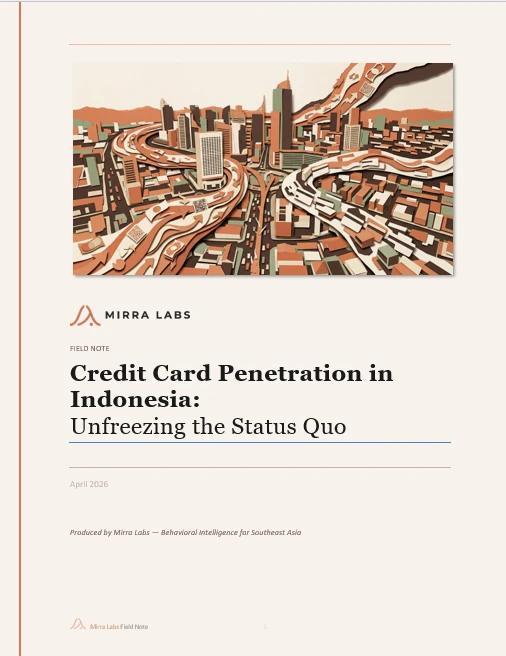
Report cover — insurance study
Report cover — banking study
Mirra Labs Behavioral Segment Report — Indonesia
Context, methodology, and segment-by-segment findings — our primary written deliverable.
02
Visual Exhibits (Slide Deck)
"What are the key insights of the study?"
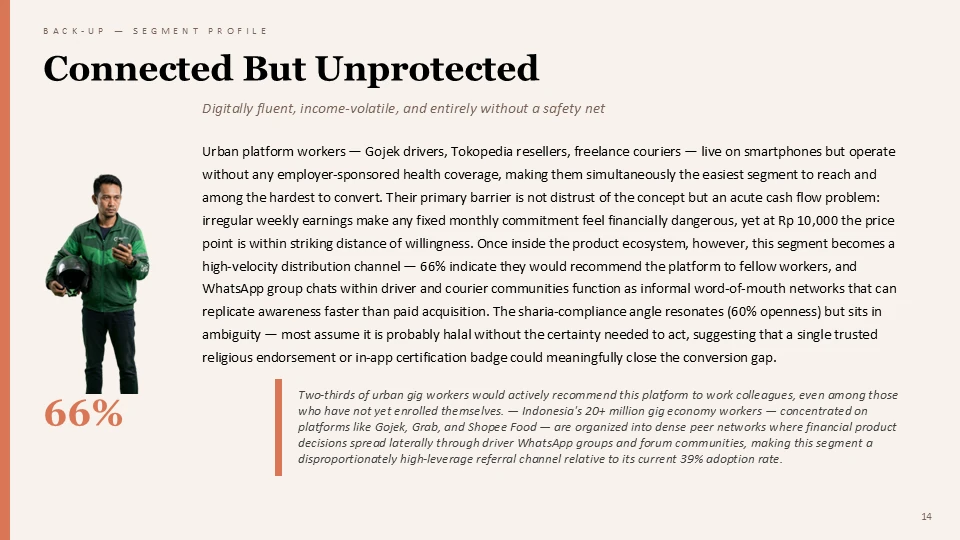
Client briefing deck — segment profile matrix
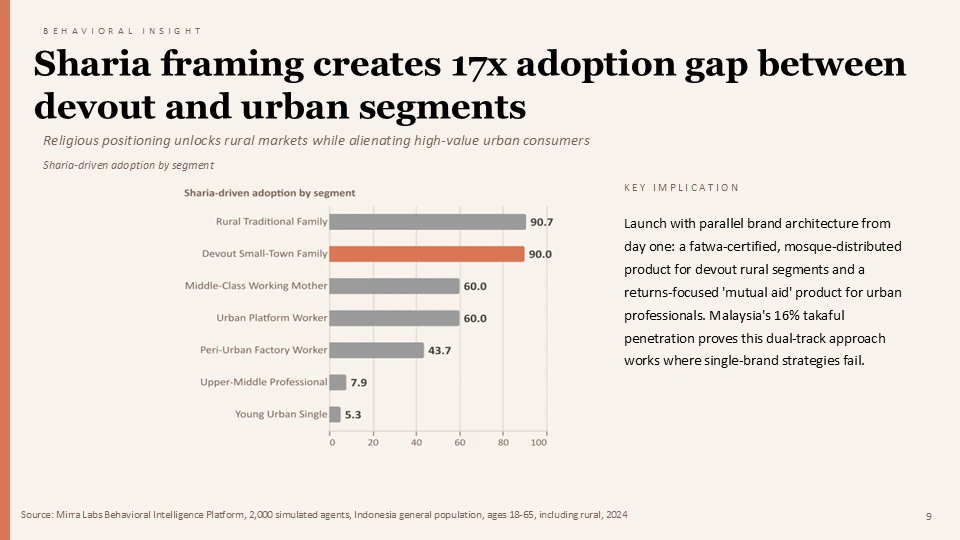
Client briefing deck — sharia framing insight
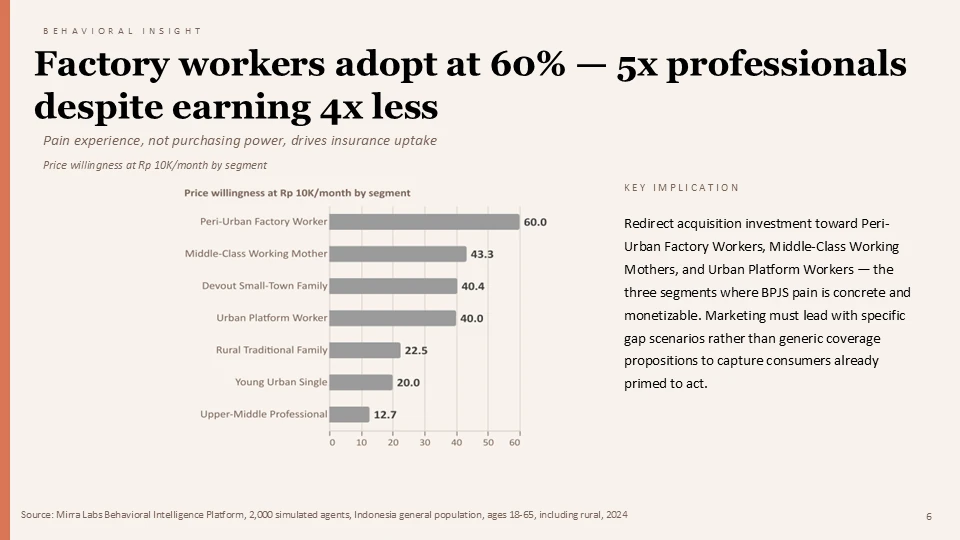
Client briefing deck — chart-heavy analytical slide
Strategic recommendation — decision-grade, action-ready.
03
Raw Data Set
"The full dataset behind the insights."
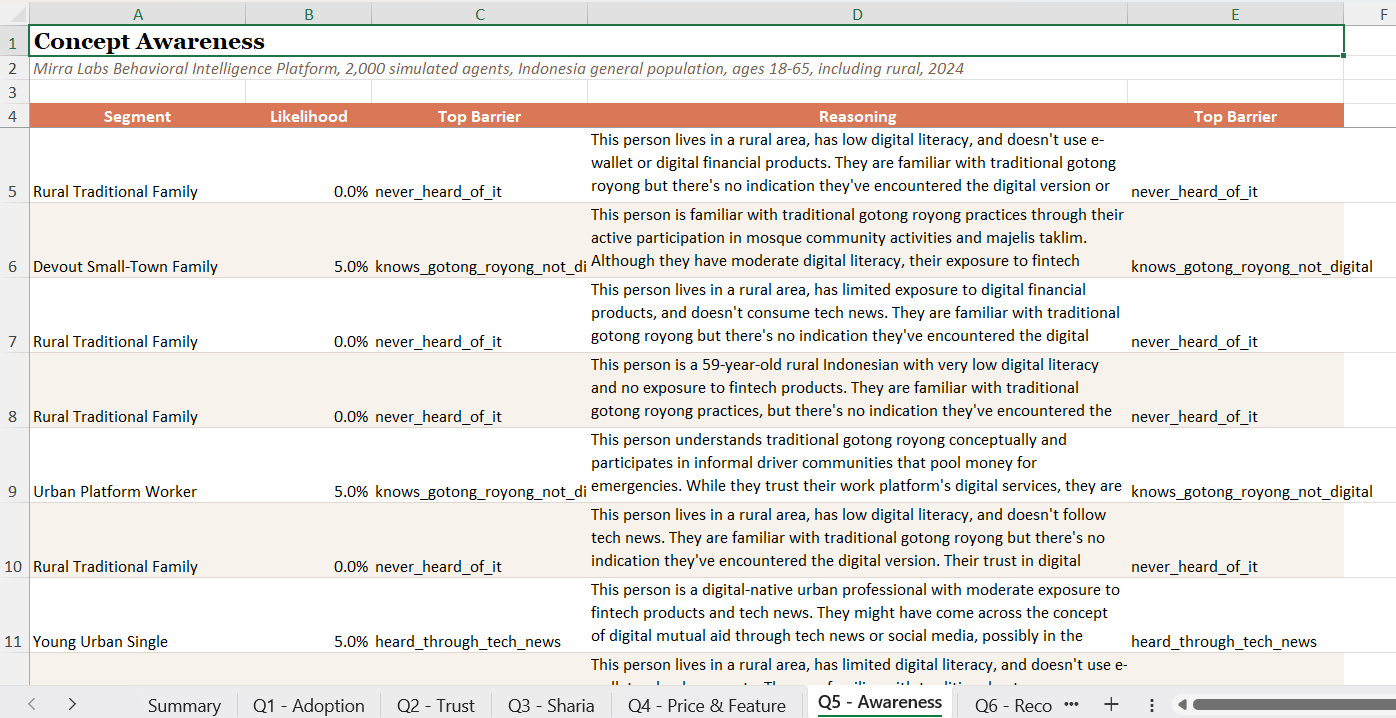
Data pack tab
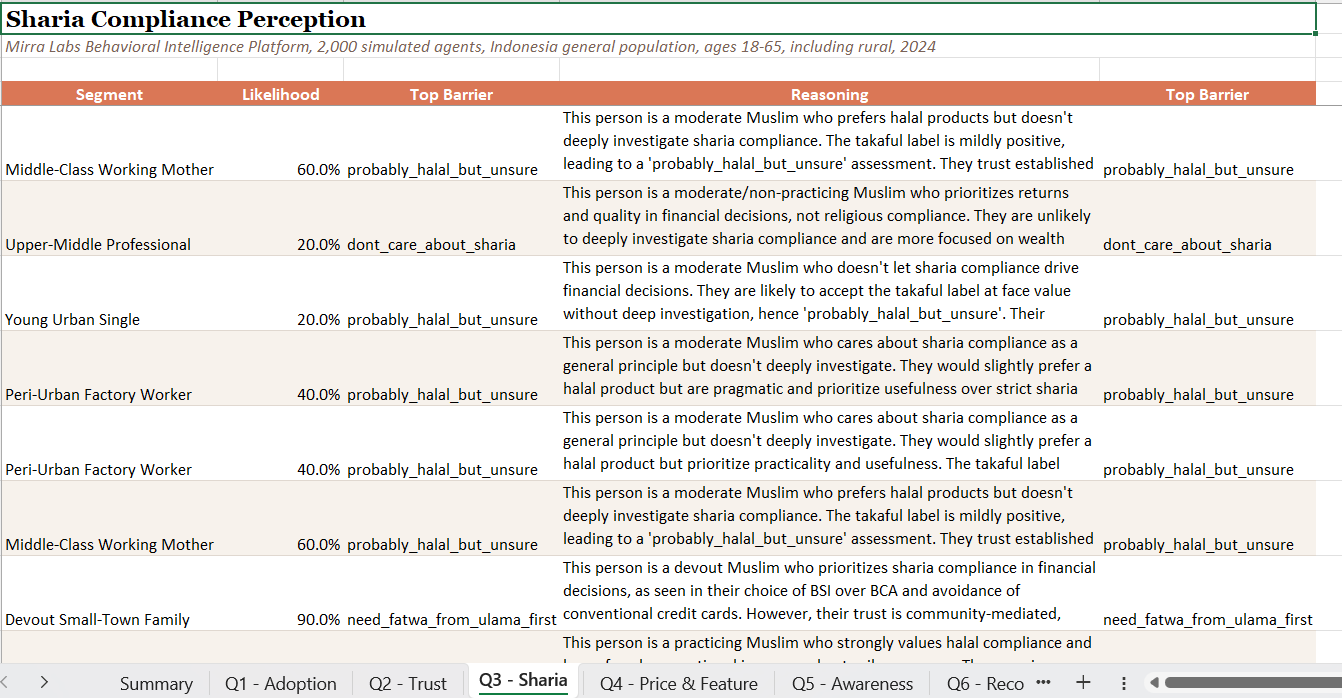
Data pack tab
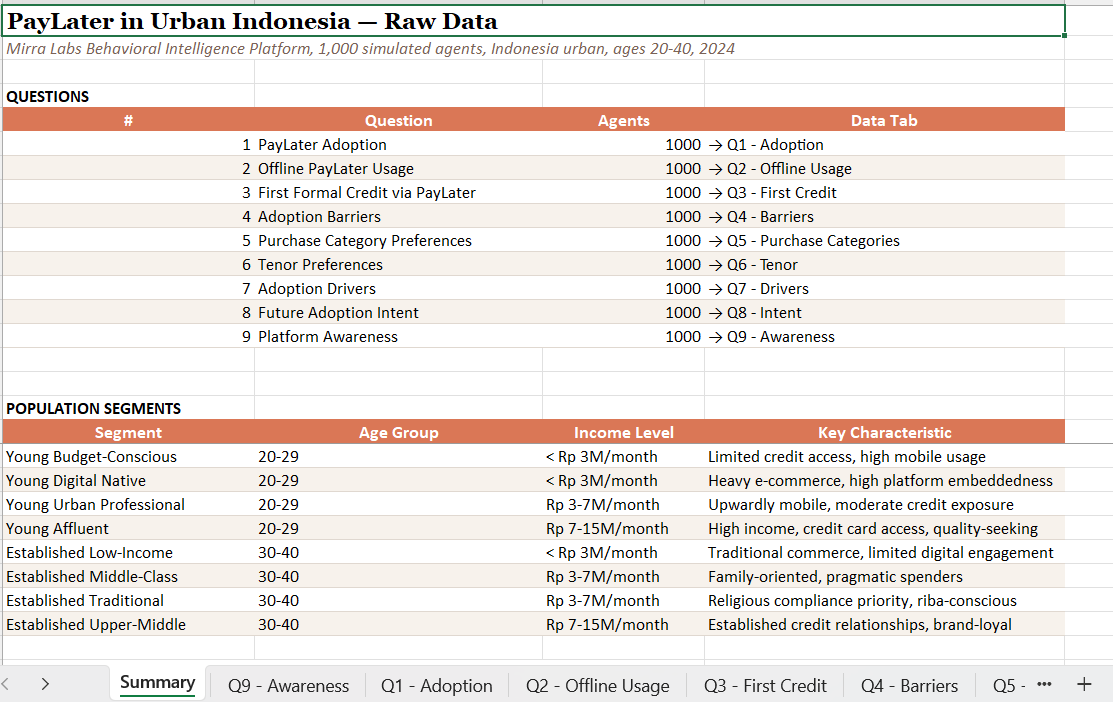
Underlying data pack — segment-level breakdowns and reasoning traces
The full depth behind every insight — slice it, pressure-test it, go deeper.

Every engagement ships a full report, a decision-grade briefing, and the underlying data pack. You don't just get the answer — you get the ability to see why.

4 The Validation Protocol — Check 4
Firewall Audit
Any reference data used to validate findings is sealed from the prediction pipeline — findings cannot be tuned to match known answers.
Validation Protocol — Final Trace
All checks passed
Check 1Source Triangulation
Check 2Blind Model Review
Check 3Behavioral Backtest
Check 4Firewall Audit

What this enables

Academic grounding

Park, J. S., O'Brien, J. C., Cai, C. J., Morris, M. R., Liang, P., & Bernstein, M. S. (2023). Generative Agents: Interactive Simulacra of Human Behavior. Stanford University.

Argyle, L. P., Busby, E. C., Fulda, N., Gubler, J. R., Rytting, C., & Wingate, D. (2023). Out of One, Many: Using Language Models to Simulate Human Samples. Political Analysis.

Horton, J. J. (2023). Large Language Models as Simulated Economic Agents: What Can We Learn from Homo Silicus? NBER Working Paper.

Dillion, D., Tandon, N., Gu, Y., & Gray, K. (2023). Can AI language models replace human participants? Trends in Cognitive Sciences.